When a brake starts losing efficiency, many mechanics choose the easiest way: replacing discs or drums with new spare parts. However, this solution is not always the most convenient—neither for the customer nor for the workshop.
Replacement implies higher costs, procurement times, and greater dependence on suppliers, while reconditioning allows restoring the original functionality of the component with less economic and environmental impact, while offering a service of higher technical value.
Thanks to Comec machines, resurfacing and regeneration become precise, fast, and professional operations, capable of improving the profitability and reputation of the workshop.
Comec responds to this need with its brake and clutch line, a set of reliable, high-performance machines designed to simplify workshop work.
The range includes lathes for discs and drums, machines for flywheels and clutch pressure plates, and brake shoe riveting and de-riveting machines—all shared by the same construction philosophy: maximum solidity, precision, and ease of use.
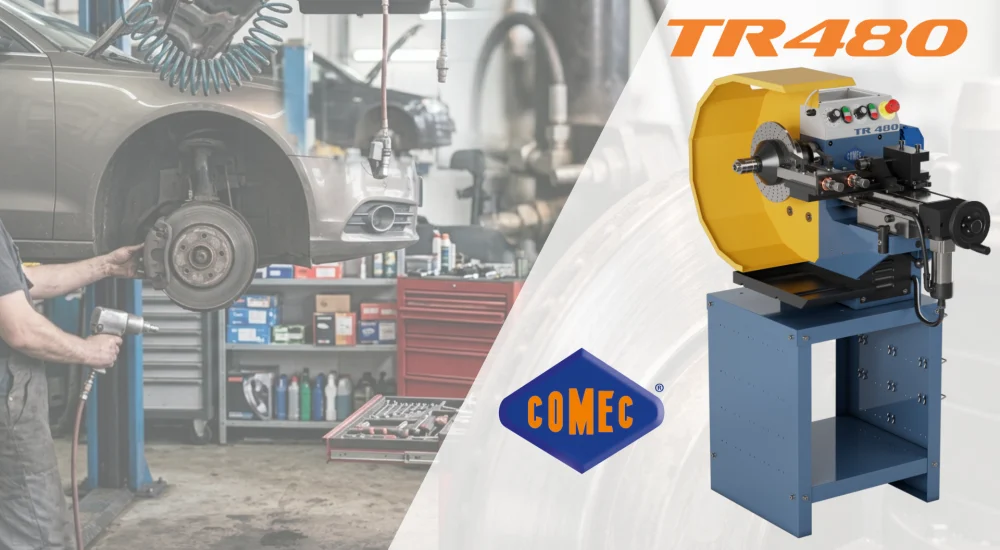
Within this offer, the TR480 lathe stands out as an ideal solution for those who wish to bring a professional level of machining to their workshop, reducing operating times and costs.
The Comec TR480 allows for the fast and precise reconditioning of any type of disc, drum, or flywheel, for both cars and commercial vehicles, and—with dedicated accessories—even heavy vehicles.
The monolithic cast iron structure, with excellent mechanical characteristics, ensures stability and rigidity even in the most demanding jobs.
The combined disc/drum tool holder allows switching from one machining operation to another without modifications or replacements, significantly reducing preparation times.
Variable speed carriage feed ensures a consistently uniform finish, while adjustable rotation allows for the correct cutting speed based on the diameter of the part.
Thanks to the Ø30 mm shaft and the centering accessories provided, component alignment is fast and precise; with options (Ø50 and Ø18 mm shafts and relative cones), the machine can also operate on discs and drums of heavy vehicles, making the TR480 a complete solution for any type of workshop.
In this section, we have collected the most frequent doubts of mechanics who want to stop being just "parts replacers" and return to offering high-value technical machining.
Why should I resurface a disc or drum instead of fitting a new one?
It is not just a matter of saving for the customer, but of efficiency for your workshop. Replacing means depending on the delivery times of parts suppliers and the costs of new components. With the TR480 lathe, you restore the original functionality of the part in a few minutes, keep the machining margin in-house, and offer a solution that reduces waste.
How much time do I lose each time setting up the machine between a disc and a drum?
Practically none. One of the strengths of the TR480 is the combined tool holder. You can switch from resurfacing a disc to a drum without having to disassemble or replace anything. This drastically reduces setup times, making the machine ready for use even for quick interventions during the day.
Can I also work on heavy vehicle components or am I limited to cars?
The machine is extremely versatile. Basically, thanks to its very rigid monolithic cast iron structure and 30 mm shaft, it is perfect for cars and vans. However, with optional accessories like 50 mm shafts, you can easily resurface discs and drums of heavy vehicles. It is a unique investment that allows you to never say no to a customer, whatever vehicle they bring to the workshop.
What kind of surface finish does the TR480 lathe guarantee?
With this machine, you get a consistently uniform and "mirror" finish. The secret is the combination of adjustable rotation and variable speed carriage feed: this allows you to set the perfect cut based on the exact diameter of the part, whether it is a small disc or a heavy vehicle drum.
Is there a risk of the customer returning complaining about brake vibrations or squealing?
The risk is practically zero thanks to the structure of the lathe. The TR480 is made of monolithic cast iron, a material that naturally "eats" vibrations and ensures extreme rigidity during machining. This ensures such a perfect surface that it avoids pedal pulsations or annoying squeals, allowing you to return the car in total safety.
